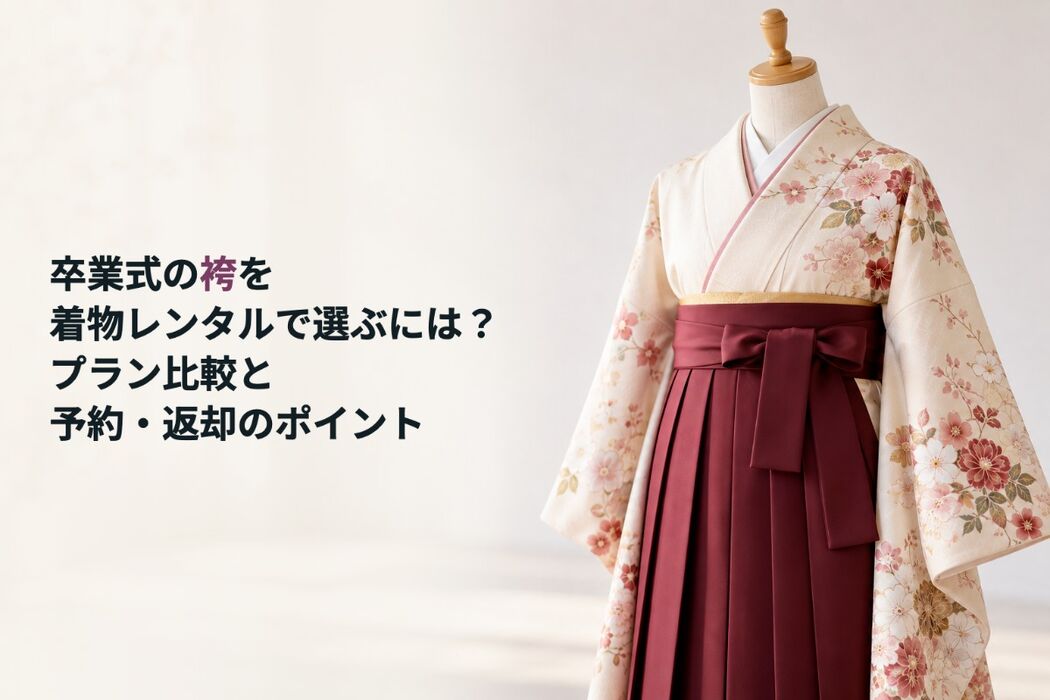
Compare the two-sleeve kimono and the furisode kimono to see the overall balance.
A nishaku-sode is a kimono with shorter sleeves than a furisode, and it's one option to wear with a hakama at a graduation ceremony. If you choose to wear a furisode, be sure to check how the long sleeves will be handled and how easy it will be to move around in. Don't just decide based on whether the venue is indoors or outdoors; consider the school's guidelines, the wearer's preferences, and what combinations will suit your activities on the day.
If you're unsure about color combinations, try incorporating colors used in the kimono's pattern into your hakama or obi. Pairing a heavily patterned kimono with plain hakama helps to clearly define the roles of the top and bottom. If you want to add some flair, use layered collars or hair ornaments, adjusting the overall look while considering the entire outfit.
Putting your preferred style into words will make it easier to discuss during your initial visit. Decide on a general direction, such as glamorous, retro, soft, or calm, and compare the options. The following table shows examples of color combinations. Since the colors and impressions that suit you vary from person to person, prioritize how the clothes look when you try them on.
| The impression I want to create |
The main color of the kimono |
Color of hakama |
Examples of accent colors in accessories |
| Glamorous and photogenic |
Beni |
navy blue |
gold/white |
| Retro and elegant |
green |
Natural |
maroon |
| Sharp and refined |
navy blue |
black |
silver/white |
The colors of the items may appear different in photos on the screen compared to the actual items due to lighting and display settings. If possible, check the colors around your face and the combination of top and bottom. For delivery-type items, confirming that the kimono and hakama are the same combination as in the photos and that you can specify the colors and patterns of the accessories will reduce confusion after receiving the item.
In addition to height, please also provide sleeve length and footwear.
Please check the size according to the rental company's size chart. Sleeve length refers to the length from the center of the back, across the shoulder, to the wrist, and is used to check how the sleeves fit. The length of the hakama (traditional Japanese trousers) will vary depending not only on height, but also on how it's worn and the footwear. Be sure to specify whether you'll be using sandals or boots when you make your reservation.
If your height falls between sizes or you are unsure about the measurements, please consult us regarding how to take your measurements. Even if an item is labeled as "one size fits all," it may not fit all body types equally well. It is important to check the sleeve length and width of the kimono, as well as the range of the hakama, and not try to compensate for the size simply by tightening the ties.
When trying on a dress, don't just check how you look standing up, but also how you look sitting, walking, and moving your arms. Make sure the hem doesn't get stepped on, the sleeves don't touch anything around you, and that the obi (sash) isn't too tight. Also, check how comfortable the shoes are, and if you'll need to change shoes at the venue, think about how you'll move and how you'll carry them to ensure a comfortable fit.
Adapting to the perspectives of students, elementary school students, and teachers.
For university, junior college, and vocational school graduation ceremonies, check the school's dress code and choose an outfit that balances your preference with ease of movement. For elementary school students, first check whether wearing a hakama (traditional Japanese formal wear) is permitted. It's also important for parents and students to discuss whether the student can manage their clothing independently on stairs and in restrooms, and who they can ask for help if they encounter any difficulties.
Even when choosing a simplified hakama set, don't skip preparations just because it's labeled as "no dressing required"; be sure to check the instructions for wearing it. Choosing an outfit that's too large in anticipation of future growth can restrict movement, so consult with a professional to ensure it fits your child's size at the time of use. Don't limit yourself to gender-based choices when selecting colors and patterns; choose based on your child's preferences and the school's guidelines.
Teachers should check the comfort of their attire, including how to handle sleeves, footwear, and how to wear their kimono, taking into account the flow of the ceremony and movement of the attendees. Parents can consult with the school about appropriate kimono attire, including what is suitable for their role as an attendee, rather than assuming that hakama are the only option. Prioritize the dress code for the ceremony rather than uniformly banning specific color combinations or patterns.